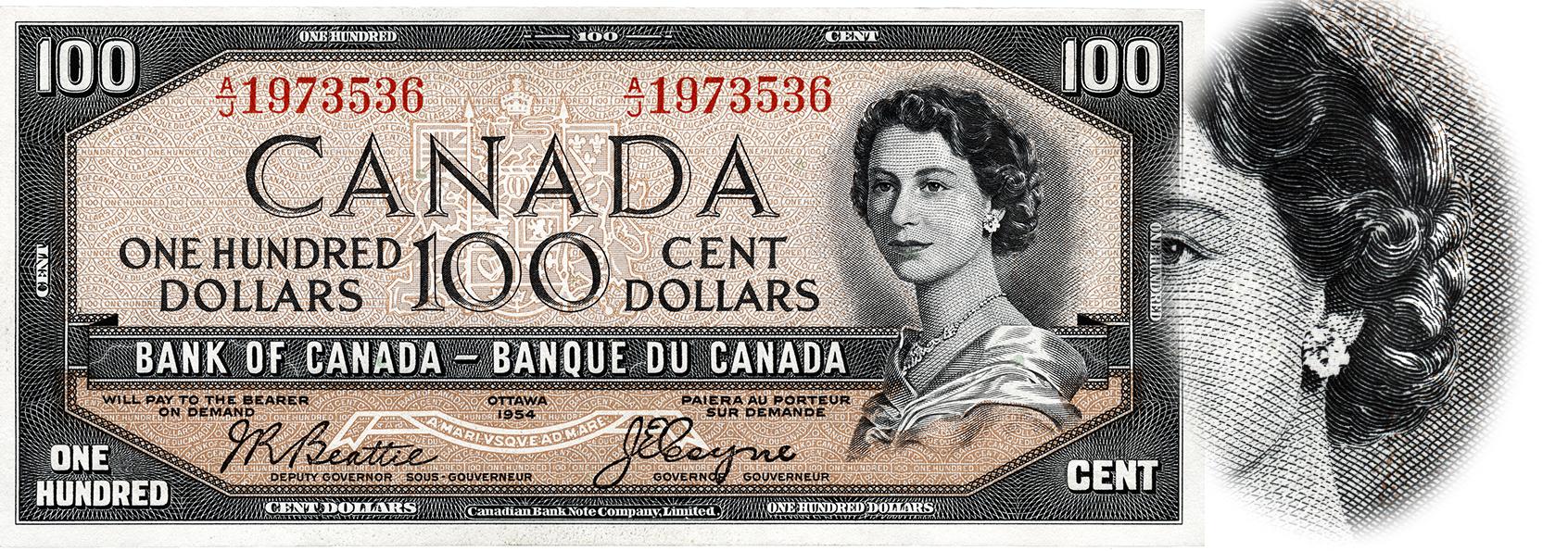
1954 $100 “Devil’s Face” banknote. Photo courtesy of the Bank of Canada Museum.
Canada’s 1954 “Devil’s Face” banknotes are one of the most intriguing pieces of Canadian currency. Often misunderstood, their story is rooted in public perception rather than in intentional design. Here’s a closer look at what these notes are, how to identify them, and what they’re actually worth today.
What is the “Devil’s Face” Banknote?
The term “Devil’s Face” refers to a series of Canadian banknotes (formally titled “The Canadian Landscape” series) issued in 1954, shortly after Queen Elizabeth II ascended the throne. This marked the first Canadian currency to feature the young Queen’s portrait across all denominations, which ranged from $1 to $1,000.
Not long after the notes entered circulation, people began to notice something unusual in the Queen’s hair. The highlights and shadows in the engraving appeared to form the image of a grinning face, complete with what looked like bushy eyebrows, a hooked nose, and a mischievous smile. Many interpreted this as a “devil’s face” hidden behind the Queen’s ear, and the term stuck.
Whether you see it immediately or need it pointed out, the illusion is striking once noticed, and it quickly became a topic of public discussion.
The Controversy and Redesign
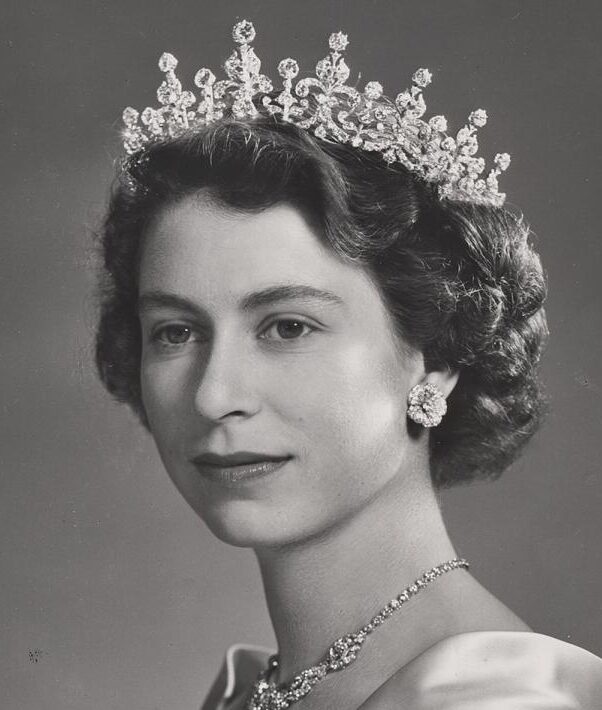 Portrait of Queen Elizabeth II taken by Yousuf Karsh. Photo courtesy of the Bank of Canada Museum.
Public reaction grew quickly, and the issue gained enough attention to reach beyond Canada. In 1956, British politician H. L. Hogg even wrote to the Canadian High Commissioner in the United Kingdom, expressing alarm over the image and suggesting it appeared too deliberate to be accidental. As the story spread, it fuelled speculation and conspiracy theories, with some blaming hidden symbolism or even the engraver himself.
The original portrait was based on a photograph by renowned Canadian photographer Yousuf Karsh and engraved by George Gunderson, Art Director at the British American Bank Note Company in Ottawa. When comparing the engraving to the original photograph, it becomes clear that Gunderson’s work closely followed the source material, and the “face” was simply an unintended visual illusion.
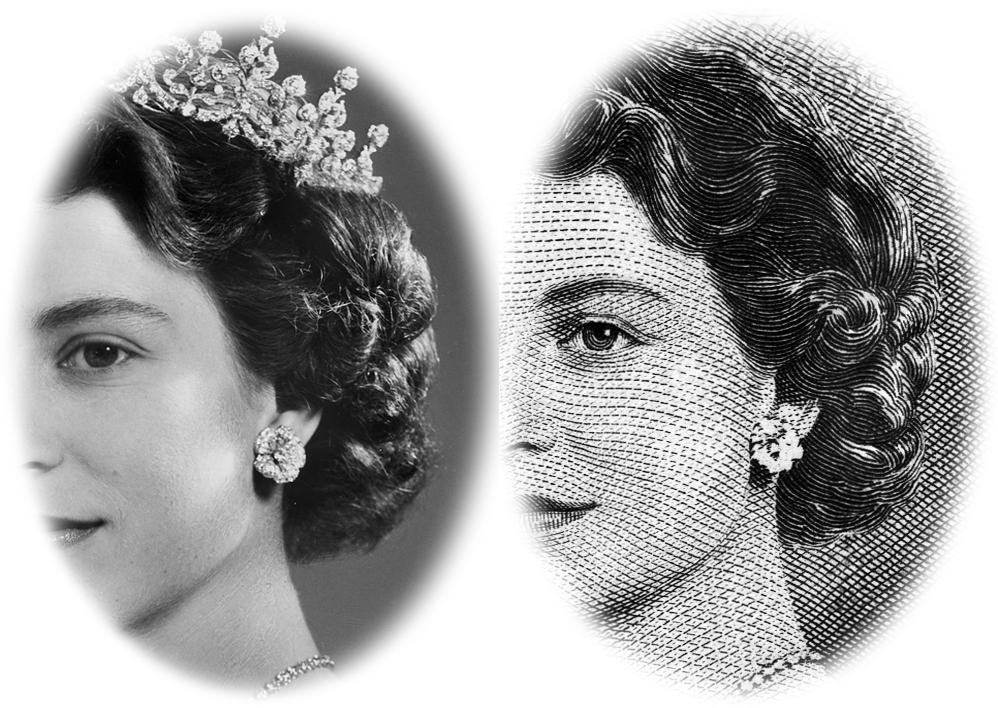 Yousuf Karsh’s portrait of Queen Elizabeth II compared with George Gunderson’s engraving. Photo courtesy of the Bank of Canada Museum.
The Bank of Canada moved quickly to revise the design, enlisting engraver Yves Baril to adjust the portrait. In 1956, the original plates were updated to darken the highlights in the Queen’s hair, removing the illusion. These revised notes are often referred to as the “Modified Portrait” series, while the originals are known as the “Devil’s Face” notes.
How to Spot a “Devil’s Face” Note
Identifying one of these notes comes down to careful observation of the Queen’s portrait. You won’t be able to tell by the date as, unlike coins, banknotes show the year the series was issued (1954), not when the individual note was printed.
Focus on the lower back section of her hair, just behind the ear. On the original 1954 notes, the pattern of highlights and shadows resembles a small face, often described as having:
- Two darkened “eyes” with bushy “eyebrows” above
- A defined, hooked “nose” shape
- A curved, almost smirking “mouth”
- A pointed “chin”
- The surrounding hair forming what looks like slicked-back hair or a forehead
On the modified 1956 versions, this area appears darker and more blended, removing the distinct shapes that created the illusion.
If you’re unsure, comparing side-by-side images of the original and modified portraits can make the difference much clearer.
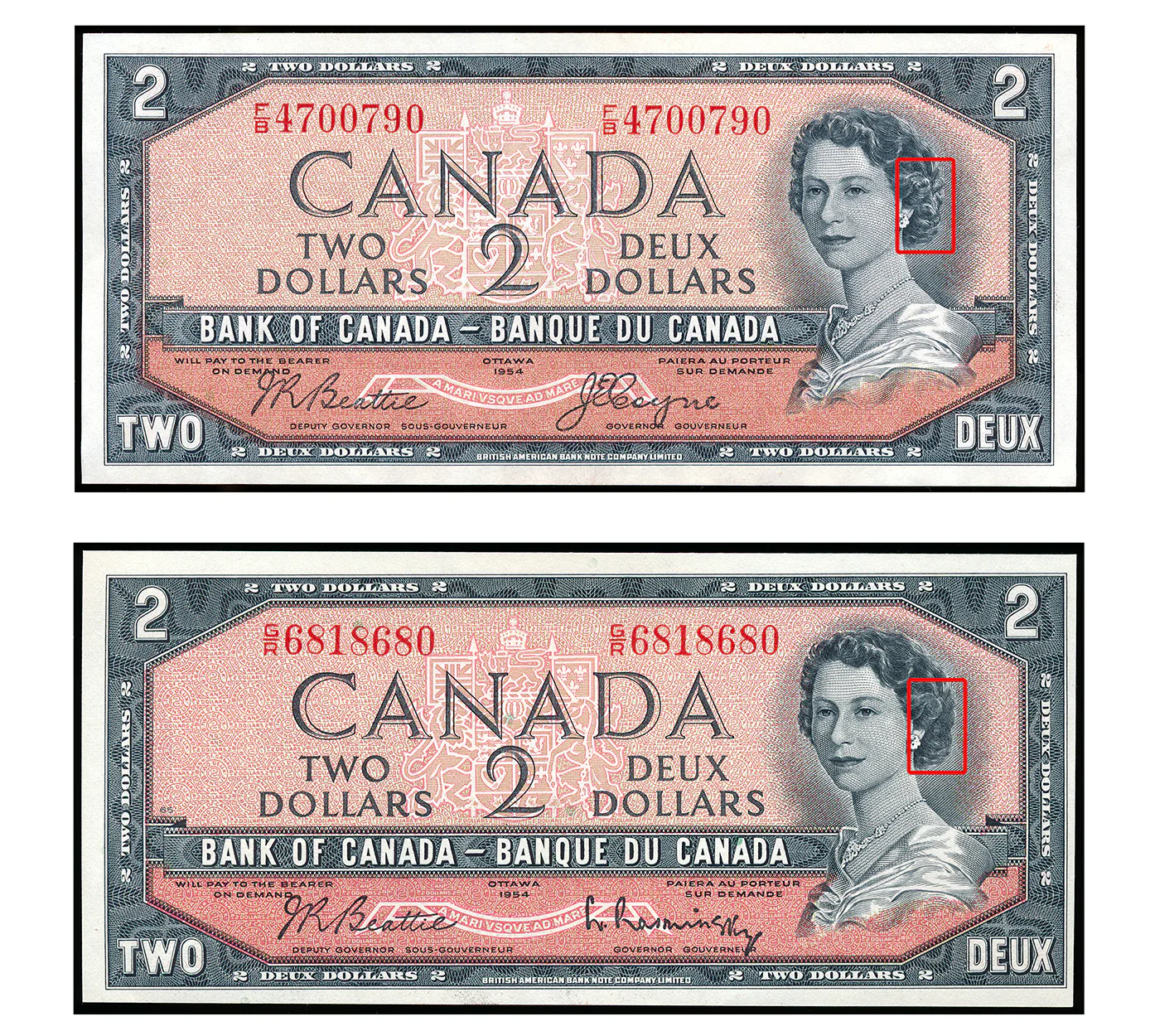 Top: 1954 $2 “Devil’s Face” banknote. Bottom: 1954 $2 “Modified” banknote. Photos courtesy of Canadian Coin & Currency.
Are They Rare?
Despite their reputation, “Devil’s Face” notes are not as rare as many people assume. Millions were printed before the design was altered, and a significant number have survived in collections over the decades.
However, rarity still depends on several factors, including:
- Denomination (higher denominations like $100 or $1,000 are naturally scarcer)
- Condition (crisp, uncirculated notes command higher premiums)
- Serial numbers (low numbers, radar notes, or consecutive runs can add value)
- Replacement notes (identified by special prefixes)\
So while the notes themselves are not exceedingly rare, specific examples can still be quite collectible.
What Are They Worth?
The value of a 1954 “Devil’s Face” banknote can vary widely. A circulated $1 note may only carry a modest premium over face value, while a high-grade, uncirculated note, especially in a higher denomination, can be worth significantly more.
Because prices fluctuate based on market demand and condition, it’s important to refer to reliable pricing guides. One commonly used resource among collectors is Coins and Canada, which provides updated estimates across different grades and denominations.
It’s also worth noting that online marketplaces can be misleading. Listings on platforms like eBay often show asking prices rather than actual sale values, which can create unrealistic expectations.
For the most accurate assessment, it’s best to visit a reputable numismatic specialist. Many of our locations are staffed with well-trained numismatic specialists, and all other locations consult with them as needed. We also work closely with our sister company, Canadian Coin & Currency, a trusted leader in professional numismatics with a legacy of serving the numismatic community since 1987.
Final Thoughts
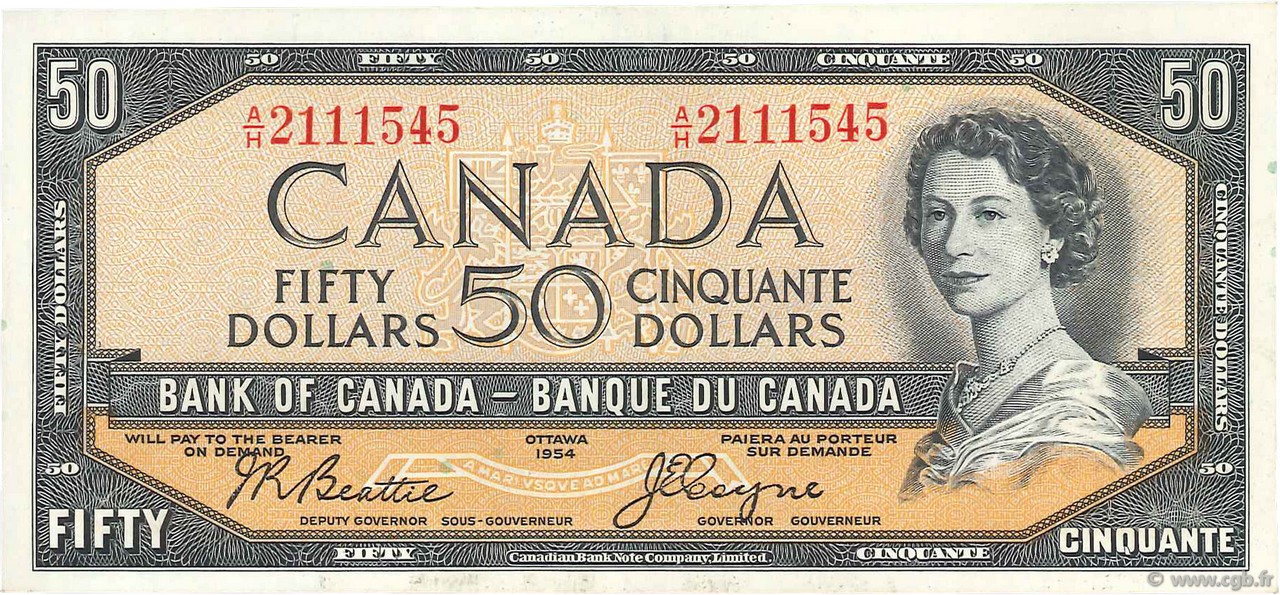 1954 $50 “Devil’s Face” banknote. Photo courtesy of cgb.
The 1954 “Devil’s Face” banknotes are a fascinating example of how perception can shape history. What began as an unintentional visual illusion quickly turned into a nationwide talking point, which ultimately led to a redesign of Canada’s currency.
Today, these notes remain a popular piece of Canadian numismatic history. While they may not be as rare as some believe, their story, distinctive appearance, and connection to a unique moment in time continue to make them highly collectible.
So, if you ever come across a 1954 Canadian banknote, take a closer look – you just might spot the famous “Devil’s Face” hidden within the details.